Wealthsimple Says AI Needs More Financial Context. Here's the Missing Part.
Wealthsimple says AI works better with more financial context. True. What they skip is how to do that without pasting your private data into a chatbot.
Wealthsimple recently sent subscribers a guide called "How to (smartly) incorporate AI into your financial planning."
The advice is solid. Use AI for financial education. Give it plenty of context about your income, tax situation, and goals. Stress-test the answers.
Then, at the end, it says: "You don't really know where your personal information goes when you paste it into an AI chatbot. Which means... don't paste it into an AI chatbot."
Both points are correct. And they contradict each other.
So now the guidance is: give AI more financial context, but do not actually give it your financial data. That sounds fine until you try to do it.
At that point you have two bad options. Ask vague questions and get vague answers. Or paste private financial data into a chat window and hope nothing goes wrong.
This is not just a Wealthsimple problem. It is the default advice almost everywhere: be more specific, but be careful.
The advice is not wrong. It is incomplete.
The missing piece was never better prompting. It was better infrastructure.
AI Does Not Need Better Prompts. It Needs Your Actual Data.
When you type "I make $85,000 and spend about $3,000 on rent" into ChatGPT, you are giving it a rough sketch. Fine for general questions. Not enough for anything specific.
You are not going to type out every transaction from the last three months. You are not going to manually list every recurring bill, the exact due dates, the amounts that fluctuate. You are definitely not going to do that every time you have a new question.
That is not a prompting problem. It is an infrastructure problem.
The questions most people actually have about their money are not educational. They are operational. What is due this week? Why was last month more expensive than usual? What subscriptions am I paying for that I forgot about? Can I afford a trip next month?
Those questions require actual data. Transaction histories. Account balances. Bill schedules. Not a paragraph you wrote from memory about your approximate spending habits.
Describing your finances from memory is guesswork. Connecting your actual data is how you get a useful answer.
The Missing Piece Is Not a Better Prompt. It Is a Connection.
MCP (Model Context Protocol) is a standard way for AI assistants like Claude or ChatGPT to read data from other apps. Your finance app holds the data. The AI handles the conversation. MCP connects the two. The connection is read-only. The AI can pull your transactions, balances, and bills, but it cannot move money, cancel anything, or take action on your accounts.
Nexafin connects your financial data to AI through a read-only MCP server. Instead of describing your finances from memory, you just ask a real question.
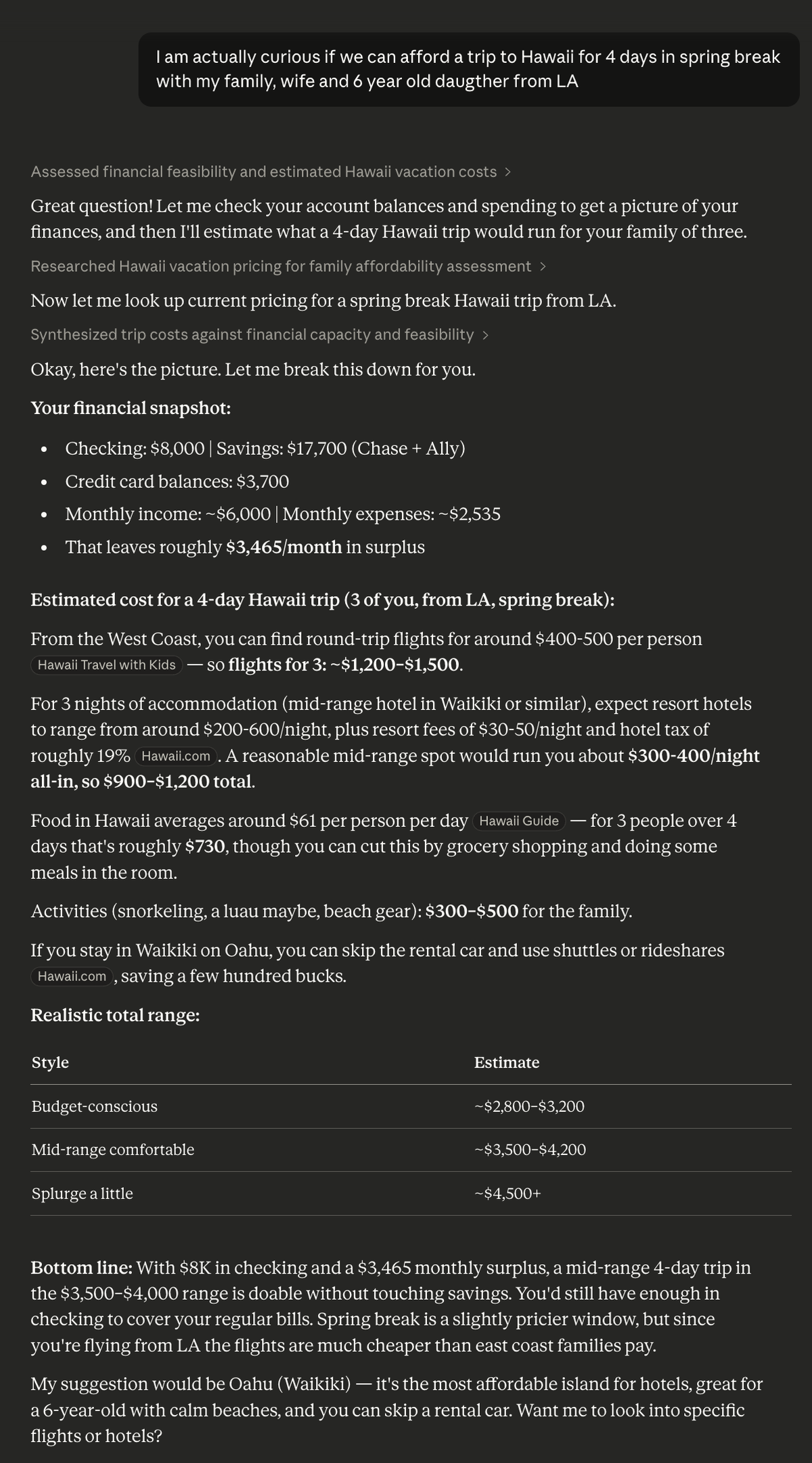
That is the difference between generic AI advice and connected financial context. Same model. Same question. Better input.
The improvement is not the prompt. It is the data access.
The AI connects through tokens. If you are not comfortable linking bank accounts at all, CSV and PDF statement imports work too. The AI access works the same way regardless of how the data got into the system.
What Wealthsimple Got Right
Wealthsimple is right to flag the privacy concern. Most people should be cautious about connecting financial accounts to new services.
But the options are not "paste everything into a chatbot" or "never use AI for your finances." There is a third option now: a structured, read-only connection between Nexafin and an AI assistant, where your credentials stay in one place and the AI only reads what you allow it to read.
That is a better answer than "be careful when pasting." And it is the part most AI-for-finance articles still leave out.
Ready to take control of your finances?
Track spending, monitor net worth, and gain clarity on your money.
Start Free Trial →