Nexafin Now Scores Your Subscriptions by Confidence (So You Stop Missing the Obvious Ones)
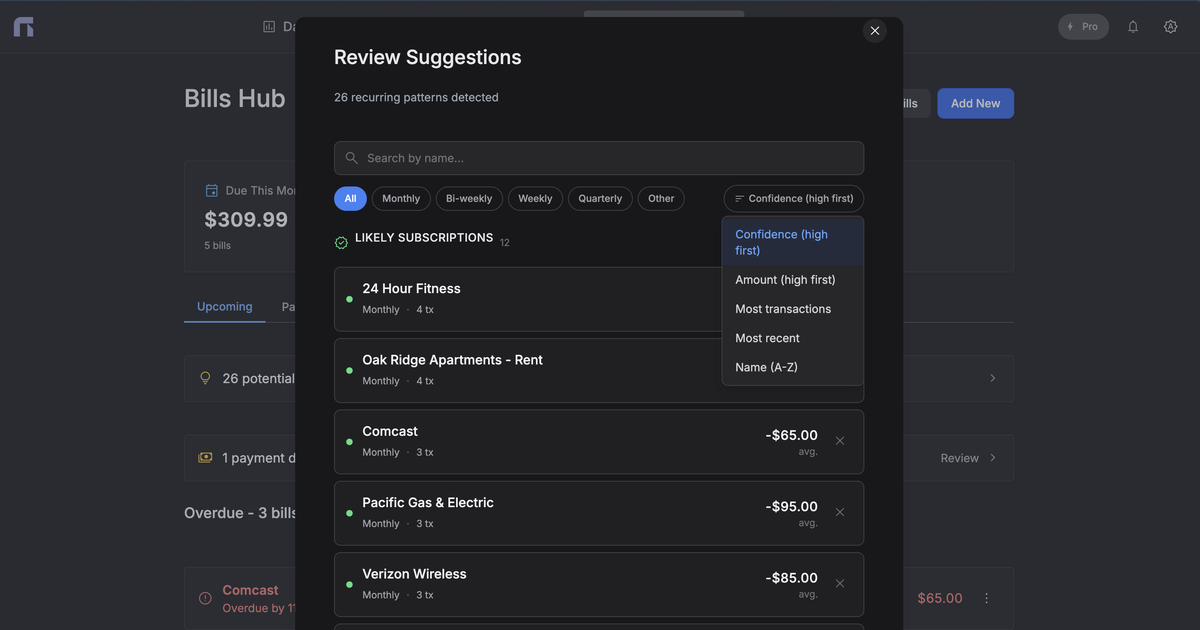
Nexafin's subscription suggestions got smarter. A confidence-based ranking system now separates likely subscriptions from other patterns, so you see what matters first.
Most subscription detection is binary. An app either flags a transaction as recurring or it doesn't. That works until it doesn't.
The problem is that not all recurring patterns are equal. Your $15.99 Netflix charge hitting on the same day every month for two years is obviously a subscription. A $47 charge that showed up three times over six months with slightly different amounts? Maybe. Maybe not.
When everything gets lumped into one flat list, the obvious subscriptions get buried alongside patterns that might not be subscriptions at all. You end up scrolling past noise to find the charges that actually matter.
We just redesigned how Nexafin surfaces recurring transaction suggestions, and the core idea is simple: confidence scoring.
What Changed
Nexafin now scores every potential recurring pattern across five dimensions: how consistent the amount is, how regular the frequency is, how many times the transaction has appeared, how recent the last charge was, and whether the pattern looks like income, which gets penalized since you're looking for expenses, not paychecks.
Those signals roll up into an overall confidence score. High-confidence patterns show up in a "Likely Subscriptions" section at the top. Lower-confidence patterns, the ones that might be recurring but need a closer look, appear separately under "Other Patterns."
The difference is immediately visible. Instead of scanning a long, undifferentiated list, you see the charges that almost certainly are subscriptions right away. The maybes are still there, just not mixed in with the obvious ones.
Finding What You Need
The suggestions view now includes search, frequency filter chips, and a sort dropdown. If you want to see only monthly charges, or sort by amount to find the expensive ones first, you can.
Each suggestion also has a dismiss button. If Nexafin flags something that isn't actually a recurring charge, you can dismiss it inline without leaving the page. It won't come back.
And if you decide to add a suggestion as a bill, Nexafin checks for duplicates first. If the charge is already tracked in your Bills Hub, it tells you instead of creating a duplicate entry.
Why This Matters
Subscription creep is real, and most people underestimate how much they're paying in recurring charges. The average American carries around 12 active subscriptions. Most people think they have three or four.
The fix isn't more detection. Most finance apps already detect recurring patterns. The real improvement is ranking the obvious charges above the borderline ones. Showing high-confidence charges first makes it easier to act on them, and when you open Nexafin's suggestions view, the difference is obvious.
One More Thing
If you're using Nexafin's MCP server with Claude or ChatGPT, your AI assistant can now pull from this same improved data. Ask it what subscriptions you might be missing, or have it cross-reference your recurring charges against your budget. The AI integration works on top of whatever Nexafin surfaces, so smarter suggestions means smarter AI answers too.
Ready to take control of your finances?
Track spending, monitor net worth, and gain clarity on your money.
Start Free Trial →